
ShieldMee Inc. · 501(c)(3) Nonprofit
Family Systems Therapy in Florida
When the problem was never one person — it’s the pattern running between all of them. As a nonprofit, what you pay goes back into training clinicians and funding care for families who can’t afford it.
Family Systems Therapy: Why You Regress Around Family (And How to Stop)
You can be a completely functional adult — good at your job, steady with your friends, calm under pressure — and then walk into your parents’ house for the holidays and become twelve years old again within the hour. That’s not a character flaw. That’s a system.
Every family runs on patterns: who plays which role, who absorbs whose stress, who gets blamed, who keeps the peace, what never gets said out loud. Those patterns get set early and run for years — sometimes across generations. And they don’t stay in the past. They show up in your marriage, your parenting, the way you handle conflict, the partners you pick, the way you go silent or go off the moment a certain person says a certain thing.
Family systems therapy is the work of understanding those patterns — and learning how to stop being run by them.
Who this is for.
- Families stuck in the same cycle — the same fight, the same blowup, the same person always cast as the problem.
- The adult who reverts at home. Fine in your real life, pulled straight back into an old role the second you’re around your family.
- Adult children still controlled by a parent’s patterns — the guilt, the obligation, the phone call that ruins your whole week.
- Couples whose fights aren’t really about each other — they’re about the families you each came from and the rules you each absorbed without choosing them.
- The one person willing to do the work even though no one else in the family will come near a therapist. (Keep reading — this one matters most.)
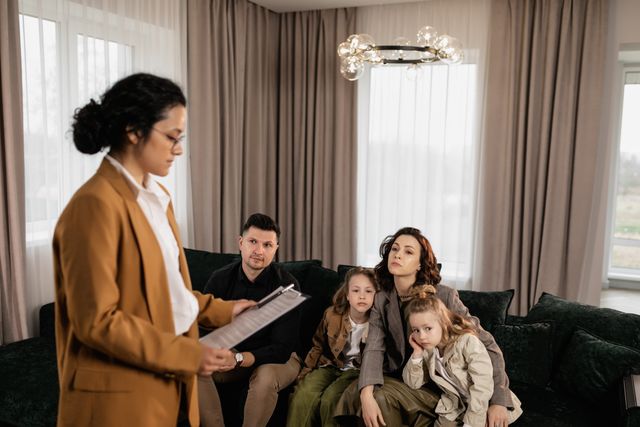
You don't need to bring your whole family.
Here’s the part most people don’t know, and it changes everything: most of this work is done by one person.
You might assume family therapy means getting everyone in a room — which, if your family involves addiction, estrangement, denial, or someone who’d sooner do anything than sit with a therapist, can feel impossible. Usually it is. But it turns out you don’t need them.
A family is a system, and a system stays balanced only as long as everyone keeps playing their usual part. When one person changes how they show up — stops
absorbing the anxiety, stops taking the bait, stops being the peacemaker or the scapegoat or the fixer — the whole system has to respond. You become the one variable that changes the equation. This is why so much of the work here is a single person, quietly changing their family from the inside, without anyone else ever setting foot in a session.
What we actually do
We map your family’s patterns and trace them back to where they started. Then we help you do the genuinely hard thing: learn to be yourself inside your family — to hold your own position without attacking, without going cold and disappearing, and without caving just to make the discomfort stop.
A lot of family pain runs on one simple move: when two people can’t handle the tension between them, they pull in a third — a kid, an in-law, an issue, a substance — to take the pressure off. The classic version: a couple that can’t face their own conflict gets intensely focused on a child’s “problem” instead. The child becomes the lightning rod, develops symptoms, gets sent to therapy — and the real issue, the marriage, stays untouched. We help you spot those moves as they happen and step out of them.

This is harder than it sounds.
An honest warning: when you stop playing your assigned role, the system pushes back — hard. The people around you are used to you being a certain way, and they will, often without even realizing it, pressure you to snap back to it. Holding your new position through that pushback is some of the most difficult psychological
work there is. It’s also exactly where the change lives.
Want the full map? This work is built on Murray Bowen’s family systems model, and we’ve laid it out in plain language for the people who want to understand the
whole thing — differentiation, triangles, how anxiety moves through a family across generations: the Bowen deep-dive. Not required reading. Just there if you want
it.
The practical details
Sessions are secure telehealth, anywhere in Florida, 53 minutes each. For families actively in crisis we may start weekly and taper as things steady; for individuals doing their own family-systems work — most of our caseload — weekly is standard. Available in English and Spanish, insurance accepted through Headway. ([Get started.].